Artificial turf installation in Miami-Dade
Serving 14 cities and the rest of Miami-Dade County, Florida
Turf suits some Miami yards and not others. This page tells you which, before anyone quotes you.
- Backyards, putting greens, pet areas, pool decks and rooftops
- One local installer, not a call list of five contractors
- Your front-yard rule, quoted from your city’s own code — all 14 researched and dated
We do not install turf ourselves. We are a referral service: we connect property owners and managers with one local turf installation professional, who sets their own availability, scheduling and pricing. Front-yard rules, city by city.
Get a free turf quote
Tell us about the project and a local turf installation professional will follow up. About a minute to fill in; rough numbers are fine. No cost, no obligation.
Five things Miami homeowners put turf on
Each of these is a different build. Say which one you have in mind on the form and the quote reflects it.
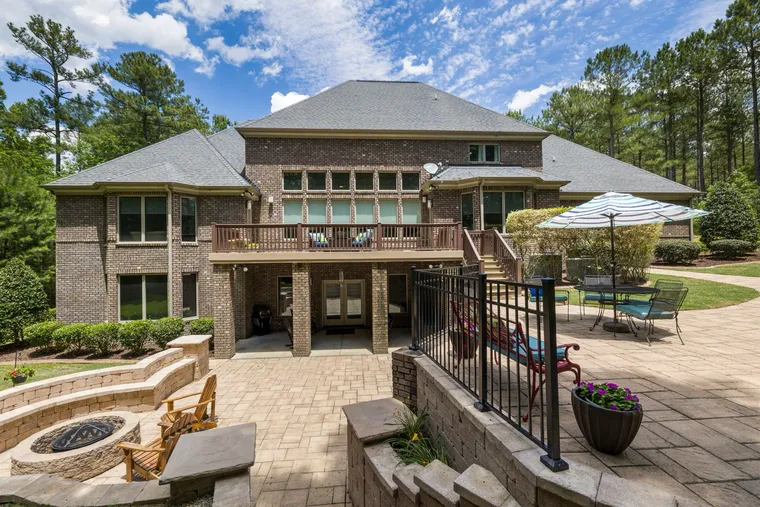
Reference photograph, not one of the installer's jobs Backyard lawns
A full or partial lawn replacement for yards where grass struggles: dense shade, heavy foot traffic, thin soil over limestone, or a watering schedule that will never be enough.
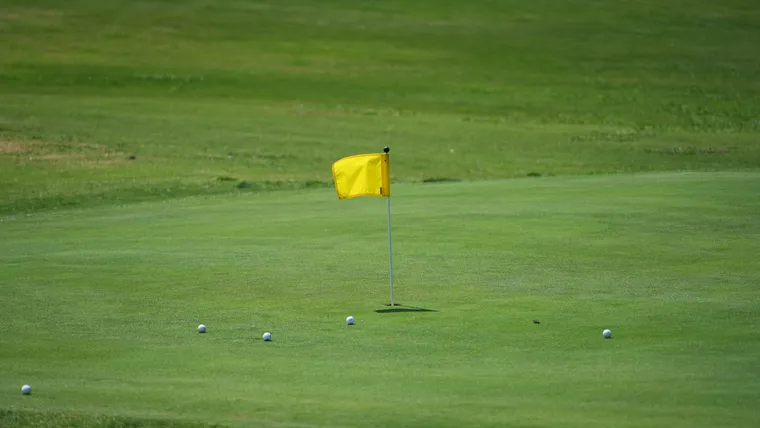
Reference photograph, not one of the installer's jobs Putting greens
Short-pile putting surfaces built as their own system: a compacted base, contours, cup placement, an infill set to the ball speed you want, and a fringe that stops balls running off.
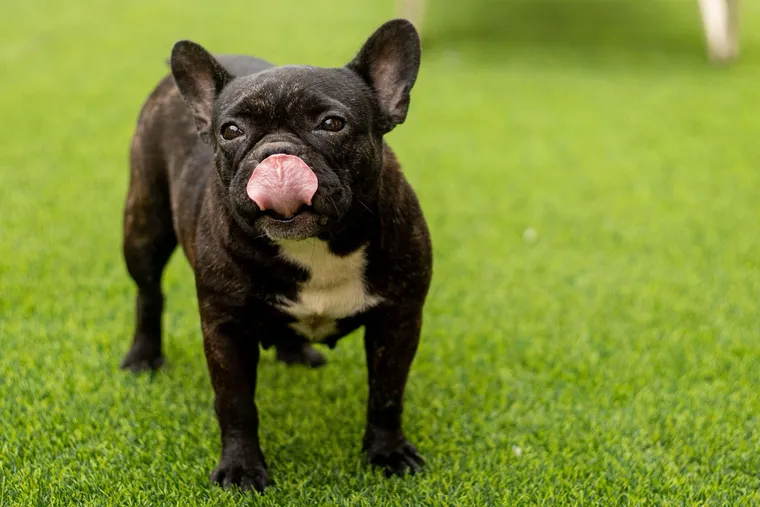
Reference photograph, not one of the installer's jobs Pet areas
Turf built to be rinsed. Perforated backing over a free-draining aggregate base, with an infill chosen for odor control rather than the default silica sand.
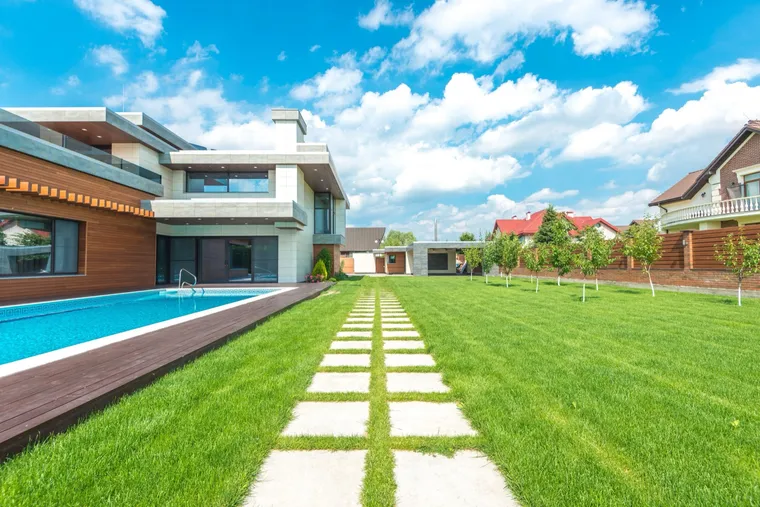
Reference photograph, not one of the installer's jobs Poolside and patios
Turf around pool decks and patios where grass never establishes and mulch ends up in the water. Edges are secured so the perimeter does not lift underfoot.
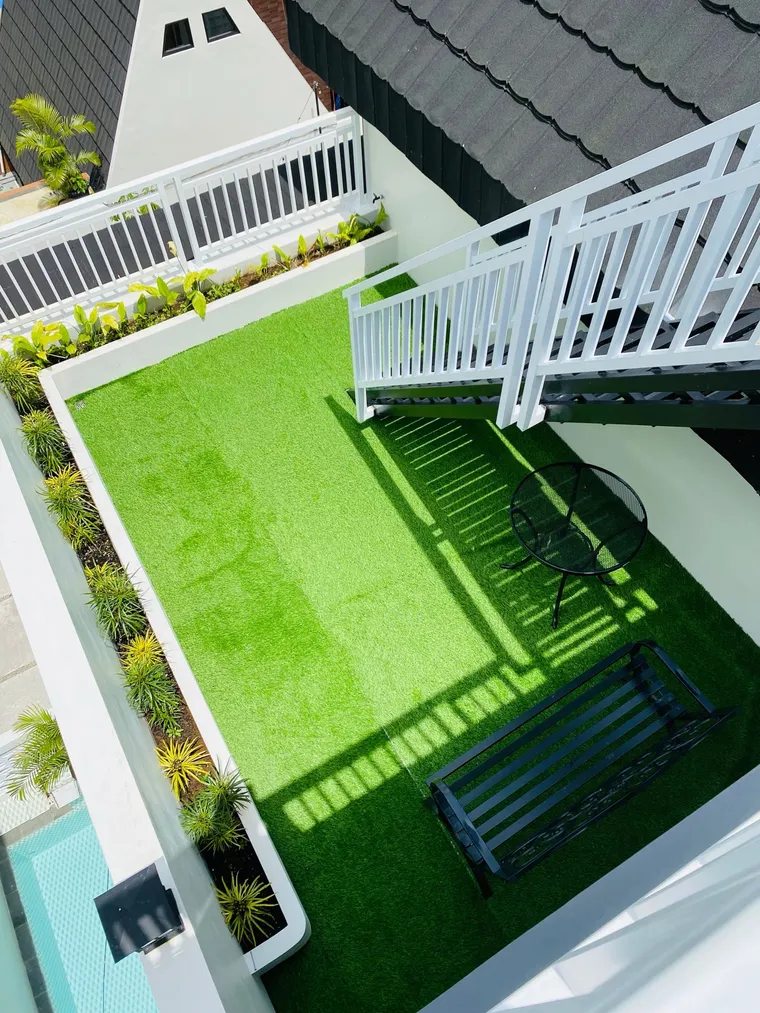
Reference photograph, not one of the installer's jobs Rooftops and balconies
Terraces, balconies and small urban courtyards, installed over existing hardscape with a drainage layer so water reaches the deck drain instead of pooling.
These five are written for a house. Association common areas, amenity and pool decks, commercial frontage and childcare play areas answer to a different set of rules, because Florida's 2026 turf standard only reaches single-family residential property — those are on the commercial page.
Why turf makes sense in South Florida
Miami-Dade has a specific set of conditions: a watering cap, a wet season, chinch bugs and thin soil over limestone. They are the reason most people here start looking at turf in the first place.
Watering here is capped year-round
Miami-Dade enforces landscape irrigation restrictions year-round, limiting most addresses to two days per week and prohibiting watering during the middle of the day. Turf takes the lawn out of that equation entirely.
Source:Miami-Dade County
The conditions that kill grass do not affect turf
Chinch bugs, sod webworms, fungus after a week of afternoon storms, and the dense shade under a mature ficus or oak are all ordinary reasons a South Florida lawn thins out. None of them apply to a synthetic surface.
Thin soil over limestone
Much of Miami-Dade is shallow sandy soil over oolitic limestone, which drains fast and holds little for roots. A properly built turf system is engineered on top of that rather than fighting it.
A wet season is a base problem, not a turf problem
A correctly graded, free-draining base sheds heavy rain rather than holding it. That depends entirely on the base being built right, which is why the process section below spends so long on it.
Read this part first: heat, upkeep and the 2026 rule change
None of them are reasons not to do it. They are reasons to make specific decisions during the quote.
It gets hot in direct sun
This is the claim to be most skeptical of when you read that turf is "comfortable underfoot." UF/IFAS reports one of its own authors measuring synthetic turf as high as 160°F at the surface, and puts a natural turfgrass lawn as much as 100°F cooler.
What helps: It matters where you put it and what goes in it. Shaded areas, and areas you use in the morning and evening, are far less affected. Hosing the surface drops the temperature immediately, though not for long. Lighter-colored and organic or coated infills run cooler than plain black crumb rubber, and are worth asking about specifically.
Source:UF/IFAS Extension
Low maintenance is not no maintenance
You stop mowing, watering and fertilizing, which is the real win. You do not stop having a surface to look after. Leaves and debris still need clearing, pet areas need rinsing, high-traffic paths flatten over time, and infill migrates and needs topping up.
What helps: In practice it is a periodic blow-off or rake, an occasional rinse, and power-brooming every year or two to stand the fibers back up and redistribute infill. Ask what the installer charges for that service while you are still comparing quotes.
The front-yard rules changed in 2026, and your HOA was not included
FDEP’s rule 62-308.100 took effect on 19 May 2026, setting statewide minimum standards for synthetic turf on single-family lots of one acre or less and limiting what a local government may prohibit. Municipal front-yard turf bans still printed in several Miami-Dade codes are, as to a qualifying lot, very likely unenforceable now. What the state did not touch is your HOA: it preempts local governments, not private covenants.
What helps: Read your city page for the rule that is actually on your municipality’s books and whether the state standard displaces it. Then confirm separately with your HOA, because that is where front-yard turf projects stall. Rear and side yards, pool decks, patios and pet runs were rarely restricted even before the state rule.
What moves the price of a turf installation
Most of an installed turf project is not the turf. These are the parts a quote is made of, so you can read one properly.
We do not publish a price per square foot
Any number quoted without seeing the yard is a guess, and the figures you find online are mostly national averages that do not reflect Miami-Dade disposal fees, our water table, or what it takes to get material through a side gate. Your quote will be specific to your site, and it is free.
- Square footage
- The largest single factor, though not a straight multiplier: mobilization, demolition disposal and equipment cost roughly the same for a small yard as a large one, so the per-square-foot figure usually falls as the area grows.
- Turf grade and pile
- Face weight, pile height, blade shape, backing and UV warranty separate a builder-grade roll from a premium one. This is where quotes diverge most, and comparing two quotes without knowing which product each specifies tells you very little.
- Demolition and disposal
- Removing and hauling existing sod, concrete, pavers or river rock is billed by volume. Miami-Dade dump fees are a real line item, and rock or old concrete costs meaningfully more to remove than sod.
- Existing grade and base condition
- A yard that already drains and sits close to level needs far less base work than one that ponds, slopes toward the house, or sits on shallow soil over limestone requiring extra excavation.
- Drainage work
- If water has to be actively moved, that is its own scope on top of the turf itself: a French drain, a dry well, a channel drain at a patio edge, or re-grading a low corner.
- Site access
- Whether a machine can reach the work area changes the labor line substantially. Base aggregate and turf rolls that have to be moved by wheelbarrow through a narrow side gate, or carried to a rooftop, take far longer than a yard a skid steer can drive into.
- Shape and cut complexity
- Curved beds, tree wells, stepping stones, pavers and tight inside corners all add cutting, seaming and waste. A simple rectangle uses noticeably less material than the same area cut into an irregular shape.
- Putting greens and pet systems
- Both are separate builds rather than upgrades. Putting greens need contouring, a finer base and a speed-tuned infill; pet installations need a free-draining base, perforated backing and an odor-control infill.
The only way to get a real number is to have someone look at the yard.
Get a free quoteFind your city's rule
You can request a quote anywhere in Miami-Dade County. What you may put in a front yard, though, depends on which municipality your address sits in, so each city has its own page.
- AventuraPermitted by use, not as lawn
- Miami GardensNo turf rule; ground cover required
- Miami BeachRear yards only
- HialeahNo turf rule in the code
- DoralFront, rear and side permitted
- MiamiFront yard prohibited by name
- Coconut GroveFront yard prohibited by name
- Key BiscayneFront and street-side yards barred
- Coral GablesPermit + rear yard
- KendallNo published rule found
- PinecrestExcluded from green space
- Palmetto BayNo turf rule; pervious minimum applies
- Cutler BayExcluded from residential districts
- HomesteadNo turf rule; existing homes exempt
Every area listed has a page of its own, naming the provision we read and the date we read it. Where a status says we found no turf rule, that is what it means: we searched the city's code and found nothing about synthetic turf. It is not permission.
A “Miami, FL” mailing address is frequently not the City of Miami — it covers much of unincorporated Miami-Dade too. If yours really is inside the city, a front-yard prohibition applies to your lot: see the City of Miami front-yard rule.
Availability, scheduling and pricing are set by the installing professional and can vary by area and season.
Three steps to a quote
Tell us about the project
Fill out the form with your ZIP code, what you want turfed and a rough size. It takes about a minute, and no detail has to be exact.
We pass it to a local installer
Your request goes to a turf installation professional working in Miami-Dade. Nothing is broadcast to a list of companies, and you will not be called by five of them.
They follow up with a quote
They reach out to confirm the details, arrange a site visit if the project needs one, and give you a written quote. There is no cost or obligation to move forward.
How artificial turf is installed
Turf lives or dies on what happens under it. This is the sequence a proper at-grade installation follows, on a yard or on a commercial site, and it is a useful checklist when you are comparing quotes.
A typical residential build-up, drawn to show the order of the layers rather than their true proportions.
- Infill
- Brushed in to weight the turf and hold the fibers upright.
- Turf fibers and backing
- Laid with the grain running one direction; seams taped and adhered.
- Compacted aggregate base
- Spread in lifts, wetted and plate-compacted to roughly 90 percent, then screeded.
- Geotextile weed barrier
- Laid over the shaped subgrade before any base goes down.
- Shaped subgrade
- Graded to fall away from the house toward an outlet. In South Florida this is the stage that carries the project.
- Perimeter edging
- Bender board, composite or nailer board for the turf to be fastened to.
Site assessment and measurement
The area is measured and walked to note grade, drainage direction, irrigation heads, tree roots, and how equipment and material will physically reach the yard. Access is one of the largest hidden cost drivers in Miami, where many yards are reached only through a side gate.
Demolition and excavation
Existing sod, roots and soil are removed, typically to a depth of three to four inches. Sprinkler heads in the turf area are capped. Removing organic material matters: anything left to decompose under the turf will settle and leave depressions.
Grading and drainage
The subgrade is shaped to move water away from the house and toward an outlet. In South Florida this stage carries the project. A flat base over our high water table is how a lawn ends up holding water after a summer storm.
Weed barrier and base material
A geotextile barrier is laid, then a crushed aggregate base is spread in lifts. The base is what the turf actually rests on; its depth and material are matched to the use, with pet areas and putting greens built differently from a general lawn.
Compaction
The base is wetted and plate-compacted in passes to roughly 90 percent, then screeded flat. Under-compaction is why a turf lawn develops ripples and low spots in its first year.
Perimeter edging and anchoring
Bender board, composite edging or a nailer board is set around the perimeter so the turf has something to be fastened to. Unsecured edges lift, and a lifted edge is both a trip hazard and the beginning of a failure.
Turf layout and seaming
Rolls are laid with the blade grain running the same direction. A mismatched grain is visible from across the yard and cannot be fixed later. Seams are joined with seaming tape and adhesive, then stitched or nailed and checked for a tight, invisible join.
Infill
Infill is brushed into the fibers to weigh the turf down, hold the blades upright and protect the backing from UV. Which infill is used is a real decision: silica sand is the default, coated sands and organic infills are chosen for pet areas or for heat, and putting greens are filled to a target ball speed.
Power brooming and walkthrough
The surface is power-broomed to stand the fibers up and settle the infill evenly, debris is cleared, and the finished area is walked with you. This is when to ask what the workmanship and manufacturer warranties actually cover and to get them in writing.
Any quote you receive should be clear about excavation depth, base material and depth, edging method, seaming method and which infill is specified. If a quote only lists a square-foot price and a product name, ask for the rest before comparing it to anything.
Straight answers, including the inconvenient ones
The questions people actually arrive with, answered at length: cost, heat, drainage, warranties, and what happens after you send the form.
How much does artificial turf cost in Miami?
We do not publish a per-square-foot number, because any figure quoted without seeing the yard is a guess. The price of the turf roll is often less than half of what an installed project costs. The rest is demolition, disposal, base material, grading and labor.
What we can tell you is exactly what moves the number: the area, the grade of turf specified, how much existing material has to come out, whether drainage work is needed, and whether a machine can reach the yard. Those are covered in detail in the cost section above.
When you do get quotes, compare the specified turf product and the base depth alongside the total. Two quotes with a large gap are frequently describing two different installations.
Does artificial turf get too hot in the Florida sun?
In direct afternoon sun, yes, and by a margin worth planning around. UF/IFAS reports one of its own authors measuring synthetic turf surface temperatures as high as 160°F, and puts a natural turfgrass lawn as much as 100°F cooler than a synthetic surface. Anyone telling you turf stays cool is not being straight with you.
What changes the outcome is where it goes and what is in it. Shaded areas run dramatically cooler. Morning and evening use is largely unaffected. Rinsing the surface drops the temperature right away, though the effect fades within a half hour or so.
Infill choice is the part most people never get asked about: lighter-colored sands and organic or coated infills run cooler than plain black crumb rubber. If you have children or dogs using the area midday, raise it before the product is specified.
Is artificial turf really maintenance-free?
No, and the honest version is still a good deal. You stop mowing, watering, fertilizing and treating for chinch bugs and fungus. In South Florida that is most of the work and most of the cost.
What remains: clearing leaves and debris, rinsing pet areas, occasionally raking or blowing high-traffic paths, and topping up infill as it migrates. Every year or two the surface benefits from power-brooming to stand the fibers back up.
Ask what your installer charges for periodic brooming and infill top-up, and get that number into the quote itself. It is a routine service, and knowing it in advance avoids a surprise later.
Can I install artificial turf in my front yard in Miami?
This changed in 2026, and most Miami turf sites have not caught up.
Florida law now sets statewide minimum standards for synthetic turf on single-family lots of one acre or less. FDEP adopted the implementing rule, 62-308.100, effective 19 May 2026. Where it applies, a local government can no longer prohibit a compliant installation or regulate it inconsistently with the state standard. So a municipal front-yard ban that is still printed in a city code is, as to a qualifying lot, very likely unenforceable.
That does not make the local codes irrelevant, and they differ more than you would expect. Key Biscayne bars turf from front and street-side yards. Cutler Bay excludes it from its single-family residential districts entirely. Miami Beach permits it in required rear yards. Coral Gables requires a permit and pushes it to the rear yard. Aventura permits it on terraces and pool decks but not as a general lawn. Pinecrest lets you install it and then refuses to count it as green space. Doral, at the other end, expressly permits front, rear and side yards, and is the only one whose code requires your HOA to approve it first.
The City of Miami prohibits it in the front yard outright, which almost no one reports: Miami 21 Sec. 5.3.6 bars gravel and artificial turf from the First Layer — the front yard — of T3 single-family property by name, a rule that sits in the transect standards rather than the landscape article and that neither of the widely-circulated Miami 21 copies contains.
Note too that a "Miami" mailing address is frequently not a City of Miami address, so establish which municipality you are actually in first. Cities can also still require a building permit to confirm you met the state standard. Read your city sheet for what applies at your address.
The part that surprises people: your HOA is not preempted. Section 125.572 binds local governments, not private covenants, and § 720.3045 only protects turf that is not visible from your frontage, an adjacent parcel or a community golf course. So the state can stop your city from banning front-yard turf and still leave your HOA free to do it.
We have not been able to confirm whether any specific Miami-Dade city has amended its code text in response to the state rule. Treat the above as the legal effect of the statute and rule as adopted, not as an answer about your address. Your municipality is the place to confirm that.
The full rule, quoted from the adopted text, and who it reaches
Does any of this change for a commercial, HOA or condo property?
Yes, and in the opposite direction to what most people assume. The 2026 state standard is written for single-family residential property of one acre or less. A commercial, industrial, multi-family or association-owned parcel sits outside it, so there is no state floor under your municipal code and no state ceiling over it. The ordinance binds in full, and a city that can no longer stop a homeowner can still stop you.
The private layer is not preempted either. Section 720.3045 protects a parcel owner against the association, and only where the turf is not visible from the frontage, an adjacent parcel or a community golf course. A condominium operates under Chapter 718, which the turf statute does not mention at all.
A few Miami-Dade codes speak to non-residential turf directly. Aventura permits it on rooftop and above-ground terraces and pool decks in residential and non-residential development, and names sports fields and playgrounds. Hialeah writes its certification and three-year recertification regime for residential-office, commercial, industrial and multi-family property, so the single-family exemptions do not reach you.
Source:Fla. Stat. § 125.572 — synthetic turf on residential property — The Florida Legislature
Will it drain during the rainy season?
A properly built system drains faster than most natural lawns. Turf backing is perforated, and water passes through it into the aggregate base beneath.
The turf is not the variable; the base is. Water has to get through the backing, through the base, and then somewhere. If the subgrade was not graded to an outlet, or the base was not compacted and free-draining, water sits under the turf. That is the failure mode to ask about, and it is why grading and compaction are separate stages of the process.
On a site with a high water table or a low corner, expect drainage work — a French drain, dry well or channel drain — to appear as its own line on the quote. A quote that includes no drainage scope for a yard that currently ponds is worth questioning.
Is it safe for dogs, and does it smell?
Turf is widely used for pet areas, and dogs generally take to it quickly. Liquid passes through the perforated backing rather than pooling.
Odor comes from waste left on the surface and from infill that traps it, not from the turf itself. A pet installation should be built differently: a free-draining aggregate base, fully perforated backing, and an odor-control infill such as a coated or zeolite-based product instead of the default silica sand.
Solids need picking up as they would on grass, and the area benefits from periodic rinsing. If those two things happen, odor is not usually an issue. If a quote for a pet area specifies standard infill and a standard base, ask why.
How long does artificial turf last?
Manufacturers commonly warrant residential turf for something in the range of eight to fifteen years, typically against UV degradation and fiber loss rather than against wear. Actual service life depends heavily on sun exposure, traffic and how well the base was built.
The two warranties are separate and both matter. The manufacturer warranty covers the product; the installer's workmanship warranty covers seams, edges, wrinkling and settling. Those are the failures that happen. Get both in writing, and read what the workmanship warranty excludes.
Can turf go over concrete, pavers or a rooftop?
Yes, and it is common on balconies, terraces, small courtyards and pool decks. The build is different from a ground installation: instead of excavating and building a base, a drainage layer or padding goes down over the existing hard surface and the turf is bonded or secured to the perimeter.
The thing to get right is where the water goes. The existing surface has to still drain to its outlet — a deck drain or a scupper — with the turf on top of it. On a rooftop, weight and any building or association rules about deck alterations need checking first.
How long does installation take?
A typical residential yard is usually a two-to-four day job once it starts: demolition and excavation, then base and compaction, then turf, seaming and infill. Small areas can finish in a day.
The schedule is more often set by what comes before the crew arrives than by the installation itself: quoting, product availability, drainage scope, and permit or HOA approval where those apply. Sustained heavy rain can push a base stage.
What happens after I submit the form?
Your request goes to a local turf installation professional serving Miami-Dade County, who follows up to confirm details and arrange a quote. It is not broadcast to a list of contractors, and you will not be called by five different companies.
Miami Turf Installers is a referral service. We do not install turf ourselves, and pricing, scheduling and the work itself are handled by the installing professional. There is no cost and no obligation.
Ready for a number on your yard?
Send the details and a local turf installation professional will follow up to confirm the scope and put together a written quote. It costs nothing and commits you to nothing.
- Goes to one installer, not a list
- No cost and no obligation
Request your free quote
About a minute. Rough numbers are fine; the installer will confirm the details.